 |
 |
 |
Trans Texas Airways
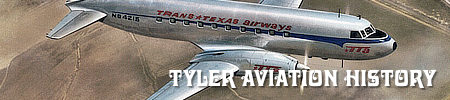
One of our favorite airlines that served Tyler's Pounds Airport over the years was Texas' own Trans Texas Airways (TTA).
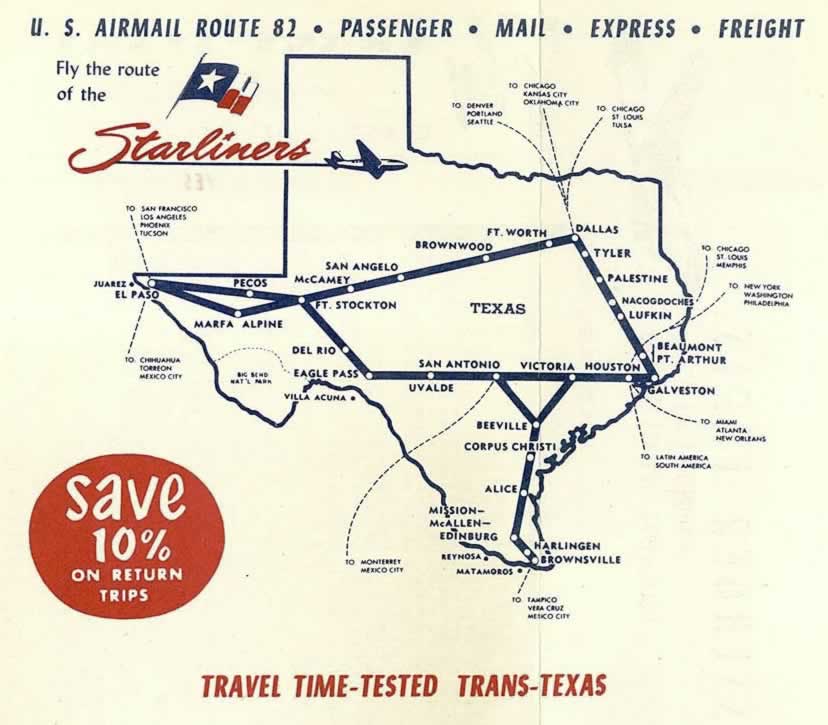
Its roots date to 1944 when it was founded in Houston as Aviation Enterprises. Upon receiving its air mail and passenger carrying charter from the Civil Aeronautics Board in 1947, it changed its name to Trans Texas Airways and began service from from Houston to Dallas, San Antonio and El Paso.
Initially, it used a small fleet of Douglas DC-3 aircraft purchased from American Airlines. Many of us from that era will recall the airline's nicknames: "Tree Top Airlines" and "Tinker Toy Airlines".
During the 1950s and 1960s, TTA operated a small fleet of about 25 Convair 240 and Convair 600 aircraft, as well as DC-3s.
As with the DC-3s, the Convair airliners were purchased from American Airlines, whose maintenance records indicated the aircraft were in extremely good condition.
Major airports served included Hobby in Houston, Love Field in Dallas, and Amon Carter Field - Greater Southwest International Airport in Fort Worth. Many other smaller cities were served, including Longview, Lufkin, Lafayette, Lake Charles, and Tyler.
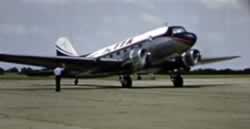
Trans Texas Airways DC-3 at Tyler Pounds Airport
The Route of the Starliners |
Trans Texas Airways 1966 flight schedule and timetable for Tyler Texas 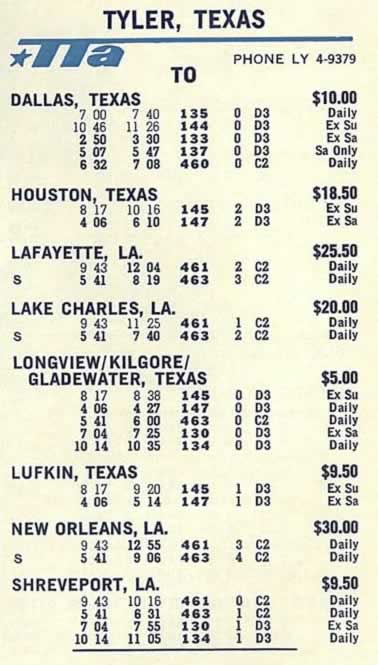 |
In 1967 TTA purchased a fleet of McDonnell Douglas DC-9 jets, nineteen of the Series-10 model and seven of the longer Series-30 aircraft.
Trans Texas Airways McDonnell Douglas DC-9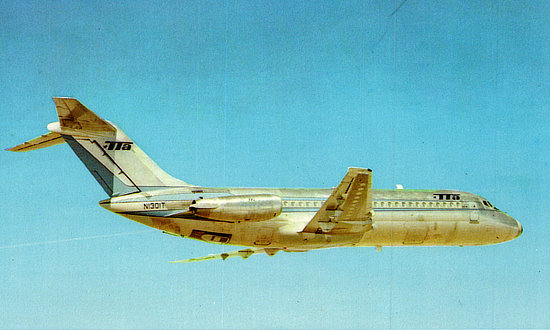 |
Texas International Airlines McDonnell Douglas DC-9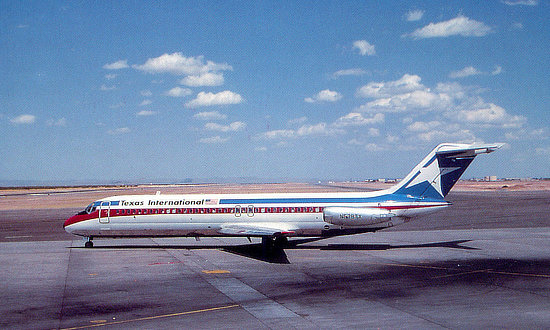 |
 |
The company remained under the TTA name until 1969 when it became Texas International Airlines (TIA), and evolved into a regional airline serving 66 cities in 6 states, and Mexico.
In 1972, after suffering annual losses of up to $3 million, Texas International was purchased by Jet Capital Corporation under the leadership of businessman and entrepreneur Frank Lorenzo.
When Lorenzo took control, TIA was near financial collapse, having lost money since 1966. But by 1978, a restructured and revitalized TIA reported net income of over $13 million.
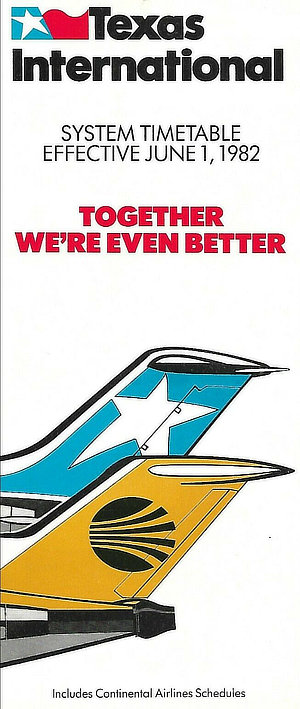
Lorenzo restructured TIA further in 1980, forming a holding company called Texas Air Corp, and in July of 1982, Continental Airlines and Texas Air approved a "financial merger" of the companies.
Although Texas Air remained the parent company, the combined companies began operating under the Continental name and colors. The legacy of Trans Texas Airways and Texas International Airlines was over, but not forgotten.
Tyler Aviation Resources on this Website |
| Pounds Airport (TYR) Overview Pounds Airport History Stewart Airport History Tyler Area Airport & Landing Strips History HAMM Museum Trans Texas Airways |
 |
||
 |
 |
 |